|
| Lichens, Tardigrades, and SO2 | Guided Research Data Analysis |
|
Creating the Context Home Research Focus Background Info Research Methods Data Submission Results of Study Data Analysis Conclusion Further Research Guided Research Research Question Background Info Research Methods Data Submission Results of Study Data Analysis Conclusion Further Research Research Values Student Research Doing Research Publish View Tools Discussions Email List Lichen Links Lichen Map Image Bank Project Awards
|
So, now that I have my data, what do I do with it?Visualizing DataGraphs are one way to visualize data and to help the researcher look for patterns. A graph is used to show the relationships of data collected from the experiment. Graphs must be constructed accurately and accoring to accepted rules. Usually, a graph shows the relationship between two kinds of data. These data are called variables. In this research the variables are percent lichen coverage and tardigrade density and tardigrade diversity. These are two types of variables. The independent variable is data that influences the outcome of the experiment. Often the experimenter has control over this variable. Time is a very common independent variable. This data is plotted in the horizontal axis, x axis. In our research we are going to explore the relationship of percent lichen coverage and tardigrade density and diversity. Percent lichen coverage is our independent variable. The dependent variable depends on the conditions of the investigation, and frequently on the independent variable. The dependent variable is sometimes refered to as the outcome variable. The dependent data is plotted on the vertical axis, the y axis. In our research we have two dependent variables, tardigrade density and tardigrade diversity. Remeber when you make graphs;
Spreadsheets will offer you a graphing options for your data but it is very important that you understand the graph you have made and that the graph accurately represents your data. Construct a bar graph of the data you have downloaded.
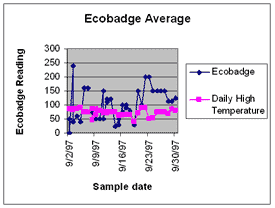
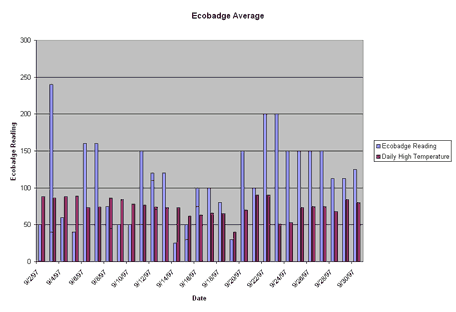 While bar graphs are interesting and a good way to visualize data, they have some problems. This graph does not allow us to really explore the relationship between lichen coverage and tardigrade density. Construct a three-variable line graph of the data you have downloaded.
 Making a Box Plot John Tukey has developed which gives greater prominence to the dispersion, the spread of the data. This method is known as a boxplot, or a box-and-whisker plot. To learn how to construct a boxplot. The following is a boxplot of the data represented in the bar graph and in the line graph. 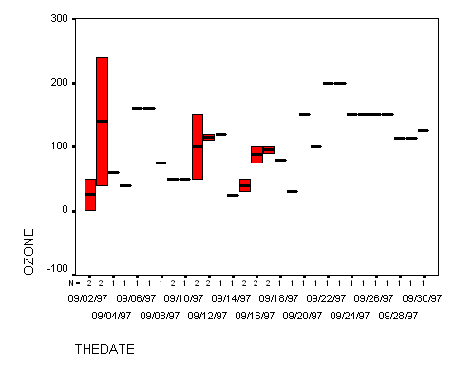 Hypothesis Testing This research was set up with two hypotheses. The null hypothesis, H0, states that events will not change, not differ and alternative hypothesis, H1, states that events will differ from some baseline standard or control conditions. This change (dependent variable) predicted by H1 will be due to the occurrence of an experimentally controlled variable (independent variable).
H0: There is no measurable relationship between the percent lichen coverage and the density and/or diversity of tardigrades living on the lichens. H1: There is a measurable relationship between the percent lichen coverage and the density and/or diversity of tardigrades living on the lichens. Actual hypothesis testing consists of several stages:
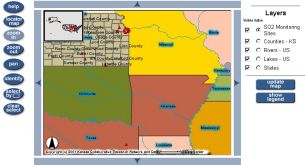
Using Geographic Information Systems for Analysis A geographic information system (GIS) is a computer-based tool for mapping and analyzing things that exist and events that happen on earth. The data that we have collected as a part of this project is well suited to GIS technology because it has a critical geographic dimension. GIS integrates common database operations such as query and statistical analysis with the unique visualization and geographic analysis benefits offered by maps. These abilities distinguish GIS from other types of analysis.
Mapmaking and geographic analysis are not new, but a GIS performs these tasks better and faster than do the old manual methods. And, before GIS technology, only a few people had the skills necessary to use geographic information to help with decision making and problem solving. A GIS stores information about the world as a collection of thematic layers that can be linked together by geography. This simple but extremely powerful and versatile many real-world problems from tracking delivery vehicles, to recording details of planning applications, to modeling global atmospheric circulation. I would like to work with the data in a map-based format.
|
| © 1997-2003 PathFinder Science |