
|
| Global Warming | Creating the Context Data Analysis |
|
Creating the Context Home Research Focus Background Info Research Methods Data Submission Results of Study Data Analysis Conclusion Further Research Guided Research Research Question Background Info Research Methods Data Submission Results of Study Data Analysis Conclusion Further Research Research Values Student Research Doing Research Publish View Tools Discussions Email List Warming Links
|
So, now that I have my data, what do I do with it? Means and Extremes The methods and number of steps used in gathering scientific knowledge may vary from one investigator to the next, but scientific methods usually involve the alternation of two types of activities, the observational and the explanatory. So far we have been making observations about leaf stomata, but we have not yet participated in the explanatory part of science. We can continue to explore the data we have collected so far to increase the accuracy of our observations. The data you downloaded does not really mean very much yet because we do not know whether this data is typical, high, low, or how it compares to "normal".
See if you can do a mean for the data that you have also see if you can find the extremes in your data set. Look for the highest and the lowest stomata density counts. Visualizing Data Graphs are one way to visualize data and to help the researcher look for patterns. A graph is used to show the relationships of data collected from the expreiment. Graphs must be constructed accurately and accoring to accepted rules. Usually, a graph shows the relationship between two kinds of data. These data are called variables. Time is a very common independent variable. Independent variables are plotted in the horizontal axis, x axis. In the graph below we explore the relationship between stomatal counts and the distance from the eastern Kansas border. In this graph distance from the eastern Kansas border is the independent variable. The dependent variable is sometimes refered to as the outcome variable. The dependent data is plotted on the vertical axis, the y axis. In our research the stomata counts are our dependent variable. Remeber when you make graphs;
Spreadsheets will offer you a graphing options for your data but it is very important that you understand the graph you have made and that the graph accurately represents your data. The following is a bar graph of stomata counts and distance from the eastern Kansas border. 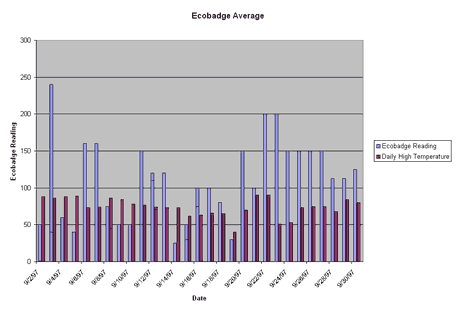 While bar graphs are interesting and a good way to visualize data, they have some problems. This graph does not allow us to really explore the relationship between stomata counts and distance from the Kansas border. (Why not?) Line graphs show the relationship between two kinds of data in which the independent variable is continous. After the proper points are plotted on the graph, they should be connected by a line. To line more about graphing and how to make various kinds of graphs, the DIGSTATS site should be helpful. The following is a line graph showing stomatal counts over and daily high temperature and represents the same data presented in the bar graph.  Making a Box Plot John Tukey has developed a technique which gives greater prominence to the dispersion, the spread of the data. This method is known as a boxplot, or a box-and-whisker plot. To learn how to construct a boxplot. The following is a boxplot of the data represented in the bar graph and in the line graph.  Using Geographic Information Systems for Analysis A geographic information system (GIS) is a computer-based tool for mapping and analyzing things that exist and events that happen on earth. The data that we have collected as a part of this project is well suited to GIS technology because it has a critical geographic dimension. GIS integrates common database operations such as query and statistical analysis with the unique visualization and geographic analysis benefits offered by maps. These abilities distinguish GIS from other types of analysis.
Geographic information systems work with two fundamentally different types of geographic models - the "vector" model and the "raster" model. In the vector model, information about points, lines, and polygons is encoded and stored as a collection of x,y coordinates. The location of a point feature, such as a bore hole, can be described by a single x,y coordinate. Linear features, such as roads and rivers, can be stored as a collection of point coordinates. Polygonal features, such as sales territories and river catchments, can be stored as a closed loop of coordinates.
I would like to work with the data in a map-based format. Using Systems Thinking - Modeling to work with data. Models are an important part of the explanatory part of science. Science is a practical study of what can be observed, and the prediction from that, of what will be observed. Models support moving beyond assimilating content to actually building understanding and effectively sharing this understanding with others. Using modeling software for analysis will build your capacity for, evaluating your models' congruence with reality and seeing complex interdependent relationships. Modeling is another tool of the practicing scientist. The STELLA software used by this project, uses a building block language that allows you to model the system of interest. The structure of virtually any system can be represented using just four icons! Sophisticated mathematics is not required to capture sophisticated relationships, as the STELLA software automatically creates the framework of equations needed to simulate the model. Once the model is constructed, simulations provide the opportunity to test the theories, observe results, and modify assumptions, thereby increasing your understanding of how things really work and how to make them work better. As you explore your data a number of questions will no doubt come to mind. Many of them begin with "Why".......which is good because it means you are ready to really begin the explanatory part of science. This process begins with establishing and refining your questions as a research question . If you do not have much experience with this process the Guided Research will help you begin working in the explanatory part of science. If you ready to jump in on your own go ahead and begin your work. If you need some helpful suggestions for how to proceed, or if you are ready to Publish My Research, this area will help you share the information you develop.
|
| © 2011 PathFinder Science |