|
|
 |
|
|
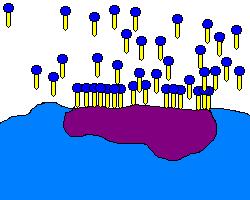
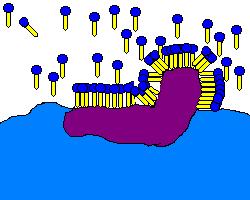
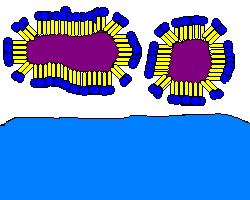
Background Information[Out! Darn Spot! IntroductionThis introduction is a little more detailed for teachers and for students in upper grades and is intended to be used as a supplement to the first background page. The word "soap" means a cleaner made with naturally occurring substances. Original soaps were made using potash and tallow. Thus, for something to be truly soap there can be no human made substances in it. The word "detergent," on the other hand, can be used for a variety of synthetic cleaners. Ingredients in detergents that do the actual cleaning are called surfactants. Surfactants are molecules that will attach themselves to and surround dirt molecules. In order to surround dirt, surfactants must first lower the surface tension of water. To understand this, we must first know a little bit about atoms and water molecules. Atoms, Molecules, and Water
There are three parts of an atom protons, electrons, and neutrons. Protons have a positive charge. Neutrons have no charge. Protons and neutrons are in the center of an atom called the nucleus. Electrons have a negative charge and travel in shells around the nucleus.
An oxygen atom has 6 electrons in its second shell which means it needs two more electrons to be stable. A hydrogen atom has 1 electron in its first shell which means it needs one more electron to make it stable. An oxygen atom will bond (join) with two hydrogen atoms, thus the two electrons from the hydrogen atoms will share with the six electrons in the outer shell of the oxygen atom. When atoms share electrons, they form a covalent bond. This bond of two hydrogen atoms and one oxygen atom forms a water molecule. A shortcut for writing this formula is H2O.
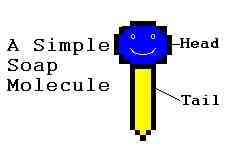
Water molecules have a strong attraction to each other. The hydrogen atoms of one molecule are attracted to the oxygen atoms of other water molecules. This forms strong connections between the molecules called hydrogen bonding. The water molecules under the surface of the water are pulled in all directions. However, the molecules on the surface are exposed to air. Since the water molecules in the air (known as water vapor) are single molecules and very far apart, the hydrogen bonds with the surface molecules are extremely weak. Thus, the surface water molecules are pulled only to the sides and down making a film or skin called surface tension. (This can be seen by putting drops of water on a penny and looking at it from the side. This is the reason many insects can "run" across water.) Soap Molecules:
Surfactants:
Soap and Detergent Additives The original soaps were harsh, irritated the skin, smelly and only did a passable job of cleaning. Another problem with soap was the hydrophilic part of the molecule bonded with minerals found in hard water forming a curd which could not be broken down by water. This problem in water causes "bathtub ring." To counteract these problems, detergents add builders which control minerals in hard water and prevent the buildup of soap scum. Another problem occurred when clothes were very dirty. The dirt would settle back on the clothes before it was rinsed away. Phosphates were added as a builder to keep the dirt suspended in water. However, it was discovered that the phosphates caused environmental problems and the use of phosphates was restricted in the 1960s. Other builders added to detergent maintain alkalinity, aid in preventing dirt from redepositing on clothes, abrasives for scrubbing, suds controllers, perfumes, colorants and brightners, which are chemicals which make ultraviolet light visible (this is why your white clothes glow under ultraviolet light).
|
|
|