Creating
the Context
Home
Research Focus
Background Info
Research Methodology
Data Submission
Results of Study
Data Analysis
Conclusion
Further Research
Guided
Research
Research Question
Background Info
Research Methodology
Data Submission
Results of Study
Data Analysis
Conclusion
Further Research
Research Values
Student
Research
Doing Research
Publish
View
|
About Tardigrades |
Tardigrade Studies |
Tardigrade Multimedia
TARDIGRADES: BEARS OF THE MOSS (Tardigrade Studies)
by
William R. Miller, Ph.D.
Originally published in The Kansas School Naturalist, May
1997.
Images can be enlarged by clicking on them.
TARDIGRADE LITERATURE
As with any biological project one must first find the general, basic knowledge of the subject upon
which to build observations and develop questions. Three major references for tardigrades are available today.
The first, Fresh-Water Invertebrates of the United States (Pennak 1978) provides a good general overview and
simple key but was published 20 years ago and is not taxonomically current. The second, Il Philum Tardigrada
(Ramazzotti & Maucci 1983) is the last monograph that attempted to list and describe all known species. It is
in Italian but an English translation is available. Finally the third, The Biology of Tardigrades (Kinchin
1994) provides an updated summary of the state of knowledge and theory of tardigrades but does not describe
species. All three have good bibliographies.
Most libraries will have journals such as Invertebrate Biology that have published papers about
tardigrades. In the last twenty years, six international symposia devoted to tardigrades have been held. The
third (Nelson 1982), the fourth (Bertolani 1987), and the sixth (McInnes & Norman 1996) have produced excellent
volumes from the papers presented. Copies of published articles are generally available from living
tardigradeologists for the cost of a polite letter.
WHAT WE DO NOT KNOW ABOUT TARDIGRADES
It is generally believed that tardigrades in the cryptobiotic state can be carried on the winds. This
would account for their worldwide distribution. Tardigrades have been found on remote volcanic islands where
dispersion could only have been by wind or birds. The debate is supported by circumstantial evidence and
awaits direct proof. What is not understood is why some apparently suitable microhabitats are not inhabited
and why tardigrades may be more common in temperate and polar regions than in the tropics.
Do animals that undergo cryptobiosis have fewer generations? Does cryptobiosis allow tardigrades to
inhabit micro environments that most other animal groups would find too harsh? Are the most advanced
tardigrades the ones that have been in the most stable environment for the longest time? From what did
tardigrades evolve?
|
|
Eighty percent of the tardigrades described are limno-terrestrial Eutardigrades. Is this the actual
makeup of the phylum or result of the collections of the last 200 years being concentrated in terrestrial
mosses and lichens? Are there more species to be found? Will there be more new marine tardigrades because the
salt water environment is less studied and harder to sample?
We know little of how tardigrades go about living normally. What do tardigrades do when active in the
moss? Tardigrades have been observed eating nematodes, rotifers, and each other, but how often and how many?
How do they find food or each other? Are they drawn to or away from light, cold, heat, oxygen or CO2? Are
tardigrades positively or negatively associated with their microscopic neighbors: nematodes, rotifers, and
springtails? How do they fit into the micro-ecosystems? What are the effects of pollutants on tardigrades?
Comparisons of tardigrades from moss and lichen samples from pristine localities and those exposed to air,
chemical, or thermal pollution has not been done.
|
|
|
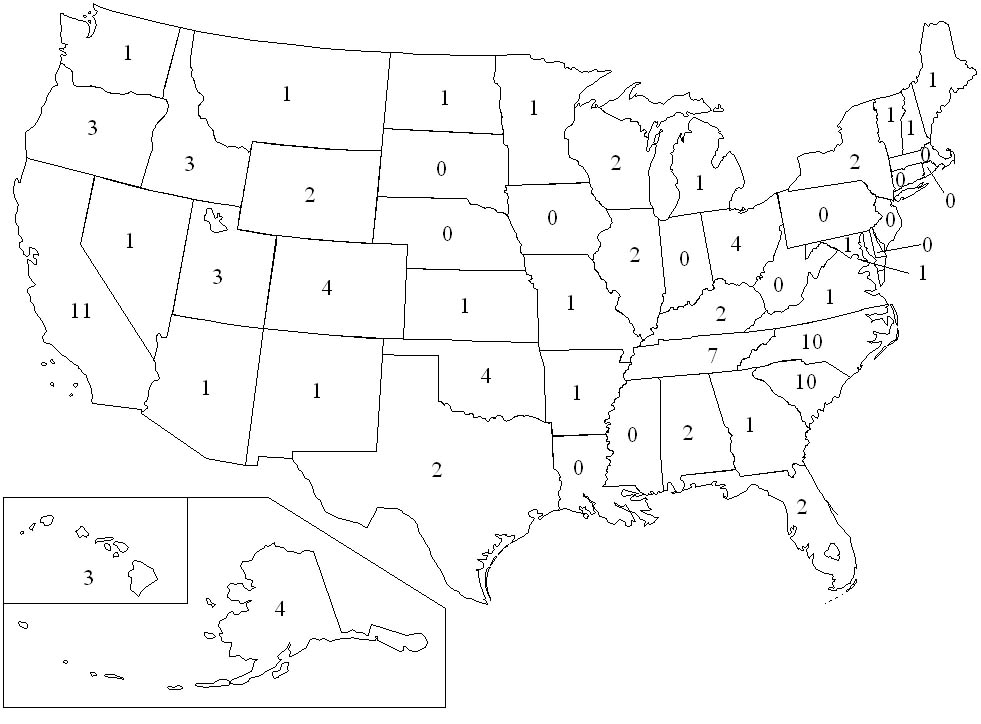
Our records of world distribution are based on only a few hundred observations (McInnes 1994). Most of
those collections are from Europe. The other continents have very few records. The reports of tardigrades in
the United States are scarce and scattered (Figure 12). Patterns of distribution within localities and
affinities for or against particular environments or elements of the habitat are only now beginning to emerge.
Almost any verified collection will add to our knowledge of distribution.
SOLVING PUZZLES
The tardigrade lives a paradox. How does it maintain life while passing through the freezing or boiling
points were the water molecule needed for metabolism expands as it changes states? How does it prevent the
cells from rupturing? Answers to these puzzles are beginning to emerge with research. For example, in the
anhydrobiosis type of cryptobiosis a tun is formed as the tissue drys out and the water is replaced by the
disaccharide sugar trehalose. Metabolism is stopped and the trehalose forms membranes that inhibit the
expansion of the remaining fluids (Roser and Colaço 1993).
|
|
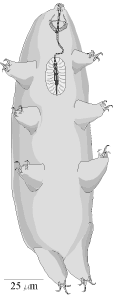
Many puzzles about tardigrades and life await to be solved. For example, only ten years ago Kristensen
(1987) stated that the 130 plus species of the genus Echiniscus were completely parthenogenic, that is composed
of only females. He proposed that over time males became smaller and less frequent as a percentage of the
population. Thus the presence of large and abundant males is though to be a statement of an evolutionarily
older and more primitive condition. Pilato (1979) speculated that parthenogenesis was an adaption for
successful passive distribution of cryptobiotic tardigrades because a single animal reaching an isolated
location has better chance of surviving and procreating than if two individuals of different sexes are required
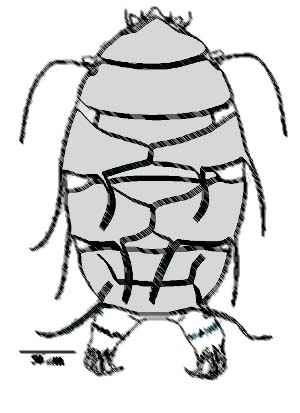
About the same time, Dastych (1987) identified males in the genus Echiniscus by describing differences
in the gonopores of specimens collected in the Himalayas and Antarctica. A few years later Claxton (1991)
reported Echiniscus with large and numerous males in the mountains of Southern Australia. Then Miller and
Heatwole (1994, 1996) found males on the Mawson Coast and in the Prince Charles Mountains of East Antarctica.
Most recently, Claxton (1996) has described several new species of Echiniscus from Australia that exhibit
sexually dimorphic characteristics in addition to the gonopore. Because of this recent evidence, we must
rethink the basic assumptions of the role of parthenogenesis and cryptobiosis as adaptations for survival in
harsh, isolated situations. |
 |
 |
Like a puzzle or a mystery, the pieces of evidence unfold, one report at a time. You work with your
data, you read what others find, and you look for patterns of sameness or contradiction. You challenge how
each fact fits into the puzzle. This is the adventure of science. There are many biological puzzles waiting
to be answered by the observant student. Most tardigrade work does not require expensive equipment, only the
tools found in a biology classrooms. It just takes a little interest and patience.
|
WORKING WITH EXPERTS
Experts can be a great source of information. To contact an expert write and explain who you are, what
you are doing, and ask for copies of papers that are relevant to your work. If you seek additional help, first
ask permission to submit questions and/or specimens. An expert will not mount your specimens nor identify your
whole collection. Most will be glad to assist by confirming examples of your identifications.
When sending specimens to an expert, send only a few good examples of each type of animal you have
found. If they are Macrobiotus, you must have eggs. Each slide must be clearly labeled and sealed with the
epoxy paint. Include a data sheet that identifies each slide, your identification, and questions; leave space
for the specialist to write a response.
For shipment use a small sturdy slide box, many science supply houses have a good one that holds 25
slides. Use tissue to pack the slides so they do not rattle and tape the box tight. Pack the slide box in the
center of a shipping container surrounded by plastic "peanuts ."
When shipping specimens internationally use the following statement on the green customs slip to
clearly describe what you are sending and avoid explanations of what tardigrades are: "Preserved, dead insects
on microscope slides for scientific research." Expect the package to be opened in the other country, so
include a page that gives your return address, phone numbers, fax numbers, etc. Tardigrades are not endangered
species. Do not send moss or lichen with soil attached; most countries do not allow soils to be imported. If
you are requested to send unmounted specimens, send them in small viles of formalin not alcohol.
If you find something important enough to warrant publication, like a new species, ask your specialist
to help you with the paper. Remember an author on a scientific paper should contribute to the science, not
just pick up the moss.
TEACHERS
Pick up some moss or scrape a lichen from a tree. Soak it in a dish. Look at it under a scope. A
whole micro-ecosystem is there. Try it and you'll be ready when a student asks for an idea for a unique
science project or wants to learn about something different. Add tardigrades to your classes by developing a
simple project that can be repeated annually.
Tardigrades offer low cost, visible results, and great biology questions. In addition, you teach
sampling, field work, lab preparation, observation, measurement, identification, literature, and writing. And
maybe the adventure of finding something new, the reward for wrestling with Tardigrades: Bears of the Moss.
References of this papers are available for further research.
|
| |
1999, KanCRN Collaborative Research Network | |